
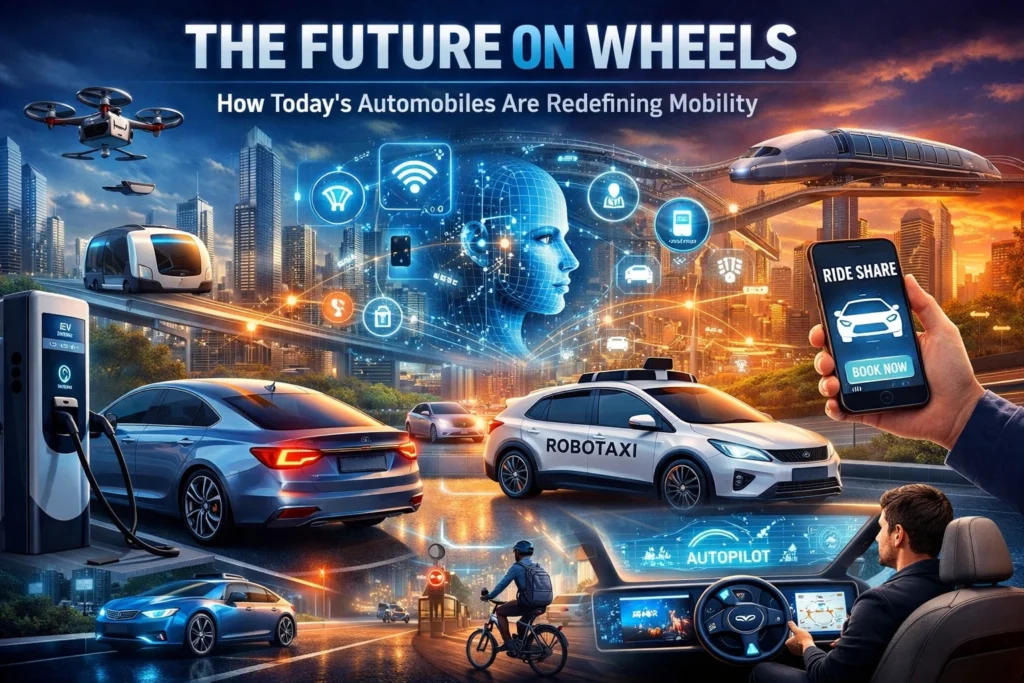
The automotive industry is currently experiencing one of its most profound transformations in history, driven by advances in electrification, connectivity, autonomy, software defined vehicles, and new business models. From the rise of electric vehicles (EVs) to the emergence of fully autonomous robotaxis, automobiles are no longer simply machines to transport people — they are redefining the way we live, work, and move through the world.
1. The Electrification Revolution
One of the most significant shifts reshaping mobility is the global transition from internal combustion engine (ICE) vehicles to electric powertrains. Accelerated by environmental regulations, consumer demand for cleaner transport, and falling battery costs, EV adoption has moved from niche to mainstream. Global market data shows EV sales growing rapidly year-over-year, partly fueled by improved charging networks and government incentives.
EVs are transforming not just vehicle propulsion but also the entire automotive ecosystem:
- Battery innovation has improved energy density and reduced costs, making EVs more competitive with traditional vehicles.
- Charging infrastructure — from public fast chargers to home units — is expanding rapidly, enabling long-distance travel without “range anxiety.” (evacad.com)
- Decentralized energy systems (including vehicle-to-grid technologies) are integrating EV fleets into broader energy grids, supporting greener electricity use.
This shift is also influencing markets differently across regions. In some countries, EVs now constitute a significant portion of new vehicle sales, while in others, infrastructure build-out is accelerating adoption. As a result, the future landscape of mobility is increasingly electrified, sustainable, and interconnected.
2. Connectivity: Cars as Digital Devices
Modern automobiles resemble smartphones on wheels more than traditional mechanical machines. With advanced telematics, cloud connectivity, and over-the-air (OTA) updates, vehicles now collect and process massive amounts of data to enhance safety and user experience.
Key aspects of connected vehicles include:
- Real-time diagnostics and predictive maintenance — cars can alert owners and service centers before problems occur.
- Vehicle-to-Everything (V2X) communication — cars can communicate with infrastructure, other vehicles, and even pedestrians to improve safety and traffic flow.
- Software-defined vehicles (SDVs) — where key systems are controlled by software rather than hardware, enabling feature upgrades remotely.
This connectivity allows vehicles to evolve over time, improving functions like navigation, entertainment, energy management, and autonomous capabilities without requiring physical workshops.
3. Autonomy: A Step Toward Self-Driving Travel
Perhaps the most futuristic shift in modern mobility is the development of autonomous vehicles (AVs) — cars that can navigate roads with little or no human input. There are multiple levels of autonomy, from Level 2 (partial driver assistance) to Level 5 (full autonomy under all conditions).
Major developments in autonomous mobility include:
- Robo-taxis: Companies like Waymo are scaling commercial robotaxi operations, offering paid autonomous rides and planning expansions into new cities globally.
- Deployment pilots: Firms like WeRide have begun public-road autonomous vehicle testing and limited commercial services in some regions.
- Advanced partnerships: Tech and automotive firms are collaborating to accelerate AV development — such as AWS expanding AI tools for autonomous driving systems.
- Innovations from CES 2026: Industry showcases — like Uber’s robotaxi powered by Nvidia — represent major near-term deployment steps.
Despite this progress, expert projections suggest widespread deployment of high-level autonomy will take a few more years, especially for privately owned vehicles. Roadmaps predict broader city-level services for robo-taxis around the end of the decade, with fully autonomous personal cars following later.
4. New Mobility Models: Shared, On-Demand, and Subscription Services
The way people access automobiles is changing too. Traditional vehicle ownership is increasingly supplemented or replaced by new models like:
- Ride-hailing and ride-sharing
- Subscription services
- Micro-mobility solutions
These options reduce the need for individual car ownership, especially in urban environments, and are supported by digital platforms that make booking and payment seamless. Shared electric and autonomous fleets promise to reduce congestion, lower emissions, and improve accessibility for non-drivers.
5. Software and AI: The Intelligent Vehicle Brain
Artificial Intelligence (AI) is becoming central to how vehicles function. Beyond just enabling autonomous driving, AI improves personalization, safety, and user experience:
- AI-Defined Vehicles use machine learning models to analyze data from sensors and adapt to complex scenarios, making cars smarter over time. (GlobeNewswire)
- Voice and biometric interfaces help drivers interact with cars more naturally.
- Predictive analytics enhance safety systems and optimize routes for energy efficiency.
As automakers adopt these technologies, vehicles are shifting from static machines to adaptive platforms that learn from their environment and user behavior.
6. Safety and Security in the Digital Age
With increased connectivity and software dependence comes an elevated focus on cybersecurity and system safety. Modern vehicles have complex hardware and software stacks, making them potential targets for cyberattacks. Researchers and industry groups are working on robust protocols and systems to protect intra-vehicle communications, secure cloud links, and safeguard remote updates to ensure passenger safety and data privacy.
Moreover, autonomous systems rely on high-performance perception technologies like LiDAR, radar, and vision sensors. Companies are scaling production of these components — with millions of units manufactured annually — to support both commercial and passenger AV deployments.
7. Regional Dynamics and Global Market Forces
Automotive transformation is not uniform globally. Different regions are advancing at varying paces due to regulatory frameworks, infrastructure, and consumer preferences:
- China is aggressively pushing connected and new energy vehicle strategies, integrating AI with transport infrastructure.
- The United States remains a leader in autonomous pilots and electric vehicle innovation, with diverse private sector R&D efforts.
- Emerging markets like India are growing EV adoption, developing local charging and adaptation of ADAS systems to local roads.
Geopolitical dynamics — including trade policies, incentives for clean tech, and supply-chain design — also influence how quickly different markets transition toward future mobility solutions.
Latest Update January 2026
Automotive Technology at CES 2026
The Consumer Electronics Show (CES) 2026 showcased cutting-edge innovations set to shape the next decade of mobility. Highlights included:
- Advanced autonomous vehicles and sensors from leading OEMs and startups.
- New concepts in connected car technologies and AI-driven user interfaces.
- Partners like Uber and Lucid demonstrating real-world robotaxi services.
AI and Autonomous Driving Expansion
Major tech collaborations such as AWS and Aumovio are rapidly scaling AI-driven autonomous systems, moving beyond research into real commercial applications — particularly in freight and robo-taxis.
Cockpit Redesign for Autonomy
Innovative hardware like foldable steering wheels (designed for Level 4 autonomy) debuted at CES, pointing toward a future where interior space and human-vehicle interaction will be reimagined.
Robotaxis on the Road
Uber’s autonomous taxi service is presently being tested with safety drivers in major cities like San Francisco, with full commercial rollout planned later this year.
These developments demonstrate that the transition from speculative visions to real mobility solutions is accelerating.
Final Thoughts
The future of mobility is unfolding rapidly and is far more complex than a simple shift from traditional cars to electric or autonomous models. Today’s automobiles are at the nexus of multiple revolutions — electrification, software-defined systems, artificial intelligence, connectivity, and shared mobility services. Automobiles are no longer just machines; they are evolving digital platforms that redefine what mobility means for individuals, cities, and societies. The world is moving toward a future where vehicles are:
- Cleaner and greener
- Smarter and more connected
- Capable of navigating themselves
- Part of integrated mobility ecosystems
- Adaptive and continuously improving through software
While challenges remain — including cyber security, infrastructure gaps, regulatory hurdles, and cost pressures — the trajectory is clear: mobility is becoming sustainable, intelligent, and ubiquitous. Today’s “car” is rapidly transforming into a mobility experience platform, reshaping how we think about getting from point A to point B — and ultimately, how we live our lives on the move.

