
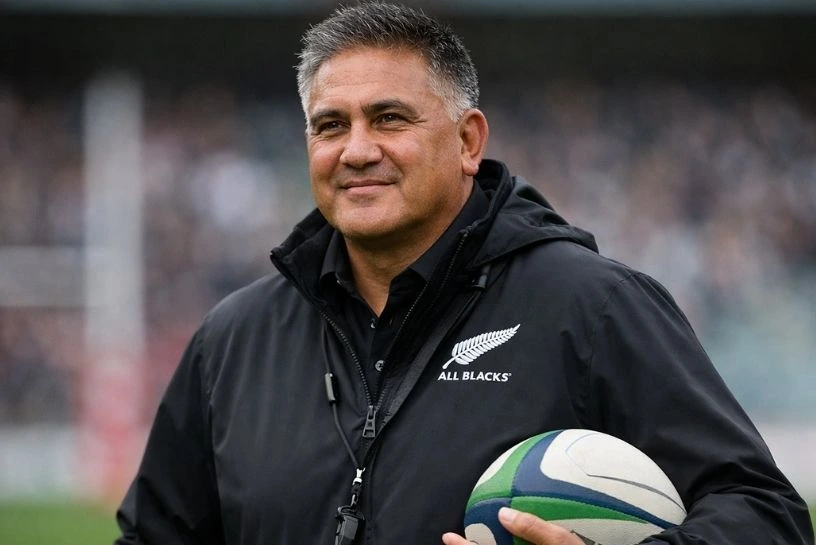
Jamie Joseph has quietly re-emerged at the centre of the rugby conversation. A respected former All Black, a proven club coach, and the architect behind Japan’s rise at the 2019 Rugby World Cup, Joseph’s trajectory over the past two seasons has put him in a prime position for greater responsibility inside New Zealand Rugby — and recent developments have only sharpened that spotlight. Below is a comprehensive, SEO-optimized update on Jamie Joseph’s career, his recent roles, why he’s being talked about as a top candidate for the All Blacks job, and what his potential elevation would mean for New Zealand rugby. This is the latest New Zealand Rugby update for fans and followers.
Quick summary (TL;DR)
Latest New Zealand Rugby Update
- Jamie Joseph returned to Super Rugby with the Highlanders, taking a leading role in 2024 and moving to head coach duties in 2025.
- In September 2025, Joseph was appointed head coach of the All Blacks XV (New Zealand’s second-tier international team) for 2025–26.
- As of mid-January 2026, with Scott Robertson’s departure from the All Blacks, media and insiders have named Joseph a leading candidate to step up to the full All Blacks head coach role.
From Otago flank to international coach — quick career arc
Jamie Joseph’s rugby life has two clear halves: player and coach. Born in 1969, Joseph played as a flanker for Otago and earned All Blacks selection in the early 1990s — he has lived the culture and pathway that defines New Zealand rugby. After retiring from playing, Joseph built a coaching CV across provincial and Super Rugby (including the Highlanders) before taking the high-profile move to Japan, where he coached the Brave Blossoms and helped modernize their game plan. His work in Japan (culminating in the famous 2019 World Cup run) cemented his reputation as a coach who can build identity and structure in bold ways.
Why Joseph’s Japan stint still matters
Joseph’s time with Japan is more than a resume line: it’s proof of a coach who can get a group to overperform. Japan’s victory over Ireland and subsequent rise to the last eight at the 2019 Rugby World Cup showcased Joseph’s tactical flexibility, player development skills, and willingness to evolve playing style — traits New Zealand Rugby often covets for the All Blacks programme. That international success changed perceptions: Joseph was no longer only a domestic coach but a global coach who could shape national identity.
The Highlanders: a homecoming and proof of domestic stewardship
Joseph’s return to Otago and the Highlanders in 2024–25 was widely welcomed as a “homecoming.” The Highlanders have long been a touchstone for Joseph (he coached them to their 2015 Super Rugby title), and his re-appointment signalled a coach intent on rebuilding a connection with New Zealand’s grassroots and Super Rugby pathways. Taking the Highlanders’ helm again placed Joseph in direct contact with the talent pipeline NZR relies on — a major plus for anyone considered for higher national roles.
All Blacks XV appointment: an intentional pathway
In late September 2025 Joseph accepted the All Blacks XV role — New Zealand Rugby’s chosen avenue to groom wider international talent and test coaching philosophies at near-Test level. That appointment was notable: it put Joseph into NZR’s performance system while keeping him visible and engaged with national selection structures. For many pundits, that move had a dual read: it was both a genuine leadership role and a signal that Joseph remained a contender for the senior All Blacks role should it open.
Latest update — why Joseph’s name is suddenly everywhere (January 2026)
The most immediate reason Jamie Joseph is dominating headlines in mid-January 2026 is institutional: New Zealand Rugby has moved to relieve Scott Robertson of his All Blacks head coach duties following an internal review, and media coverage — along with rugby insiders — has named Jamie Joseph as the early front-runner to replace Robertson. Multiple reputable outlets and NZR commentary have linked Joseph to the vacancy, noting his All Blacks XV role, his Highlanders position, and the view that Joseph is already embedded in New Zealand’s coaching pathways. If the All Blacks want a candidate who combines international experience (Japan), domestic credibility (Highlanders), and recent involvement in NZR’s development structure (All Blacks XV), Joseph fits the profile.
Strengths Joseph would bring to the All Blacks role
- Proven international pedigree — Japan showed Joseph can build identity and adapt tactics to player strengths.
- Domestic pathway knowledge — his time at the Highlanders and within New Zealand’s provincial system gives him direct access to the country’s talent pipeline.
- Player relationships and trust — Joseph’s long career across NZ and Japan means he has existing relationships inside the player cohort and with coaches who’ve worked across levels.
- A measured, team-first coaching style — observers point to Joseph’s emphasis on structure, discipline, and playing to the strengths of the group rather than forcing an ideological system. That approach can be stabilizing during a rebuild.
Potential challenges and questions
- Expectations vs. timeline: stepping into the All Blacks head coach role less than two years from a World Cup cycle is a steep ask — any incoming coach must balance immediate stability with long-term planning. Media coverage suggests NZR is aware of this.
- Staffing and backroom choices: if Joseph were appointed, discussions would follow about assistants — which names come in (and who might be poached from other nations) will matter. There’s already chatter about Tony Brown and others being desirable assistants.
- Public and player scrutiny: the All Blacks’ public profile means every decision is magnified; Joseph’s tenure in Japan and Super Rugby has prepared him for scrutiny, but the scale is larger with the All Blacks.
What insiders and pundits are saying
Across New Zealand and international outlets, the sentiment is straightforward: Joseph is a logical candidate. Commentary ranges from enthusiastic endorsement — pointing to his Japan achievements and Highlanders legacy — to caution about the timing of any coaching change and the weight of expectations on whoever is chosen. Several reputable news organisations have reported Joseph as the front-runner following NZR’s review of the All Blacks program.
What this could mean for New Zealand rugby (if Joseph is appointed)
- Continuity with Super Rugby pathways: a Joseph-led All Blacks regime would likely lean into Super Rugby and provincial structures for selection and player development, strengthening homegrown pathways.
- Tactical prudence with flair: expect structural soundness — strong defence, set-piece reliability — married with an ability to use expansive, high-skill attacking rugby where personnel suit it (a hallmark of his Japan work).
- Renewed focus on identity: Joseph’s past work shows he builds a coherent team identity; for a rebuilding All Blacks side, that may be exactly what NZR wants.
Latest factual timeline (short)
- 2016–2023: Joseph coaches Japan, culminating in the 2019 World Cup quarter-final run.
- 2024: Returns to the Highlanders organisation as Head of Rugby.
- 2025: Becomes Highlanders head coach and is appointed All Blacks XV head coach for 2025–26.
- Jan 2026: With Scott Robertson’s exit, Joseph is widely reported as a leading candidate for the All Blacks head coach role.
Final Thoughts
Jamie Joseph’s combination of international impact (Japan), Super Rugby pedigree (Highlanders), and recent NZR involvement (All Blacks XV) makes him a uniquely well-positioned candidate for a major All Blacks overhaul. Whether NZR will choose continuity, a fresh external name, or Joseph himself remains to be confirmed — but the narrative is clear: Joseph is no fringe option. He is the embodiment of a coach who knows how to develop players, create identity, and navigate both domestic and international rugby demands. For fans and stakeholders, his potential appointment represents both a nod to proven development pathways and a statement about the kind of rugby New Zealand might want to play next.

